

WHAT IS
AUDITORY PROCESSING
DISORDER or apd?
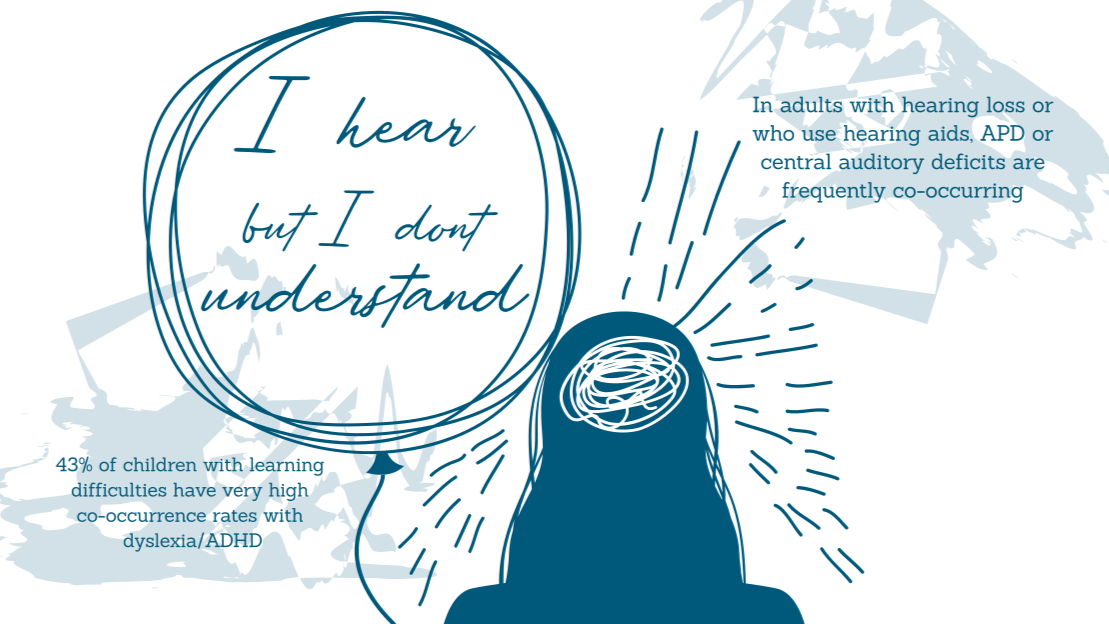
Auditory processing disorder (APD) is a condition in which the ears receive sound normally but the brain has difficulty interpreting it — especially speech in noisy places, rapid speech, or multi-step spoken information. This often causes misunderstandings, poor memory for verbal information, and trouble following conversations. APD can affect people who use hearing amplification (such as hearing aids) and is due to how the brain processes sound, not solely to peripheral “hearing” problems. APD is more common than many people realize — it affects an estimated 5% of school-aged children and frequently co-occurs with ADHD, dyslexia, and other learning differences. In adults, APD is often associated with hearing loss, aging, or history of noise exposure, including veterans with service-related hearing damage.
SOMD Wellness offers comprehensive Auditory Processing Disorder (APD) evaluations for children and adults in Southern Maryland. Our licensed Doctors of Audiology provide expert APD testing at our Lexington Park, MD clinic, serving patients from across Southern Maryland, Northern Virginia, and the Washington DC area.
WHAT are the most
common symptoms?
Difficulty understanding speech in noisy environments
Frequently asking for repetition or saying “What?”
Mishearing or confusing similar-sounding words
Trouble following multi-step verbal instructions
Poor memory for verbal information (lists, directions)
Relying heavily on visual cues (lipreading, captions)
Difficulty following conversations on the phone or in groups
Slower processing of verbal information (difficulty with rapid speech)
Fatigue or frustration after extended listening
Academic or workplace problems related to listening (e.g., poor reading comprehension despite adequate decoding)

Who performs your evaluation?
APD evaluations at SOMD Wellness are performed by our providers — Dr. Randi Pinno and Dr. Roraine Kleist both hold doctoral degrees in audiology and bring specialized expertise in central auditory processing assessment. Our evaluations follow evidence-based protocols and meet the diagnostic standards required for educational accommodations, workplace accommodations, and clinical treatment planning.
Sources:
Hearing Health Foundation. (n.d.). APD demographics. Hearing Health Foundation. https://hearinghealthfoundation.org/apd-demographics
The Auditory Processing Center. (n.d.). Prevalence of APD. The Auditory Processing Center. https://auditorycenter.com/what-is-auditory-processing-disorder/prevalence-of-apd/
Gates, G. A., & Mills, J. H. (2005). Presbycusis. The Lancet, 366(9491), 1111–1120. https://doi.org/10.1016/S0140-6736(05)67423-5
Moore, D. R. (2018). Editorial: Listening, processing and learning: A review of central auditory processing disorder. Frontiers in Neurology, 9, Article 476. https://doi.org/10.3389/fneur.2018.00476
WHAT does the evaluation involve?
Thorough Case History Review: Medical history, all prior testing relevant to current concerns, and prior hearing testing.
Peripheral Hearing Screening: Confirming that ears are functioning normally before central testing.
Central Auditory Processing Battery: Completing a series of standardized listening tasks that assess how the brain processes speech in noise, rapid speech, dichotic listening, and temporal processing.
Results & Recommendations: Explanation of findings and a written report summarizing results, diagnosis, and a personalized treatment and management plan.
Most evaluations take approximately 2-3 hours.
What treatment options
are available?
Treatment for APD depends on the type and severity of the processing difficulties identified during evaluation. Following your assessment, our audiologists will develop a personalized plan that may include one or more of the following:
Auditory training: Structured exercises designed to improve the brain's ability to process sound
Environmental modifications: Recommendations for optimizing listening environments at home, school, or work
Assistive listening technology: FM systems, remote microphones, or other devices that improve the signal-to-noise ratio
Compensatory strategies: Techniques to help patients manage listening challenges day-to-day
Collaboration with educators or employers: Documentation and recommendations to support academic or workplace accommodations


-
No, Auditory Processing Disorder (APD) is a processing disorder, not a hearing sensitivity issue. Individuals with APD typically show normal or near-normal results on standard hearing tests but struggle to understand speech, particularly in noisy environments. This is why APD is often overlooked in routine hearing screenings. However, adults with hearing loss can still benefit from an auditory processing disorder evaluation and treatment to enhance overall speech processing. This includes individuals who do not feel their hearing aid use is optimized, as well as those who have undergone cochlear implant (CI) or Bone Anchored Hearing Aid (BAHA) implantation, aiming to improve overall speech production, listening, and understanding.
-
No. Our office currently serves the population without requiring a referral, as we are not in-network with most insurance plans. Our credentialed and accredited audiology personnel will complete the evaluations, and referrals are not needed since this diagnostic test is an out-of-pocket expense due to limited insurance coverage. We offer discounts for full payments and a payment plan option upon request. Further details will be discussed at your scheduled consultation.
-
If your child consistently struggles to understand speech in noisy environments, frequently mishears words, has difficulty following verbal instructions, or has been flagged for listening difficulties at school or work — an APD evaluation may be appropriate.
-
Processing Over Sensitivity:
APD affects how the brain processes auditory information, not peripheral hearing.
Individuals with normal hearing may struggle to understand speech, especially in noise.
Assessment of Auditory Skills:
APD evaluation identifies auditory processing abilities.
Assesses skills like speech recognition in noise and following complex instructions.
Optimizing Hearing Devices:
Hearing aid, BAHA, or cochlear implant users may not communicate well due to processing issues.
APD evaluation can lead to better device optimization and personalized communication strategies.
Tailored Intervention Strategies:
Audiologists can recommend rehabilitation techniques after an APD evaluation.
Strategies aimed at improving speech understanding in various environments.
Identifying Undiagnosed Issues:
Adults with normal hearing may have undiagnosed APD.
Evaluation can lead to targeted treatments for better communication skills.
Enhancing Daily Functioning:
Appropriate interventions can improve listening skills and social interactions.
Increases overall quality of life for those feeling isolated due to communicationdifficulties.